🧬 PCR vs. Rapid Tests for Performers: What’s the Difference and Why It Matters

When your work depends on knowing your status accurately, the type of test matters as much as how often you take it. Two tests can both say “negative” and still mean very different things.
Here’s how PCR and rapid tests differ, where each one fits, and why professional performer testing relies on PCR.
What a PCR test does
PCR (polymerase chain reaction) detects the genetic material of a pathogen directly. The lab takes a tiny amount of DNA or RNA from your sample and copies it many times over until it’s easy to detect.
Because it looks for the pathogen itself, PCR can pick up an infection at very low levels and earlier after exposure. It’s the same family of technology (NAAT, nucleic acid amplification testing) that medical laboratories use as the standard for chlamydia and gonorrhea, and one of the most sensitive options for HIV.
What a rapid test does
Most rapid tests don’t look for the pathogen’s genetic material. They detect antibodies (your immune system’s response to an infection) or antigens (proteins from the pathogen). They’re designed to be fast and simple, often giving a result in minutes, sometimes without a lab.
That speed is useful in the right setting. It also comes with a trade-off.
The three differences that matter for performers
1. Window period
The window period is the time between exposure and when a test can reliably detect an infection. A test taken inside the window can come back negative even when the infection is present.
Antibody-based rapid tests need your body to produce enough antibodies first, which takes time. Depending on the specific test, the window for HIV can stretch to several weeks, and some tests can take up to 90 days to be conclusive. PCR detects the virus itself, which can be as early as 10 to 14 days after exposure.
For performers testing every 14 days, a shorter window directly shrinks the gap during which an infection could go undetected.
2. Sensitivity
Sensitivity is how good a test is at catching infections that are really there. Lab-based PCR is generally more sensitive than rapid methods, which means fewer missed infections. For chlamydia and gonorrhea, NAAT is the recommended standard in clinical guidelines for exactly this reason.
3. Site-specific testing
This matters a lot for performers. Chlamydia and gonorrhea can infect the throat and rectum independently, and these infections are almost always silent. Collecting urine, oral, and rectal samples and running them through PCR in a certified laboratory is how you actually cover all three sites. Most rapid tests aren’t designed or validated for this kind of multi-site testing.
Where rapid tests still have a place
Rapid tests aren’t useless. They’re convenient for a quick check, they’re accessible when a lab isn’t, and a positive result is a clear signal to follow up. They can also be a reasonable first step for someone who has never tested.
The limit is in how much a negative result tells you. A negative rapid test inside its window period doesn’t confirm you’re clear. For anyone with frequent sexual contact and scene partners relying on their results, that uncertainty is the problem.
Quick comparison
PCR (lab-based) | Rapid test | |
What it detects | Genetic material of the pathogen | Antibodies or antigens |
Detection timing | Earlier (HIV as early as 10 to 14 days) | Later (varies by test, up to weeks) |
Sensitivity | Very high | Generally lower |
Multi-site (urine, oral, rectal) | Yes | Typically not designed for it |
Speed | Hours to days (lab processing) | Minutes |
Best for | Routine professional screening | Quick check, follow-up needed |
What this means for your testing routine
For performers on a regular schedule, the practical takeaways are simple:
Use PCR for routine screening. It covers the earliest detection window and all three sites.
Don’t treat a rapid negative as final. If you’ve had a recent exposure, a rapid result may be too early to rely on.
Match your test to your timeline. If you test every 14 days, choose a method that can actually detect infections within that interval.
Follow up on any positive. Confirm with a healthcare provider and begin treatment promptly.
Where CLEAR Pass™ fits in
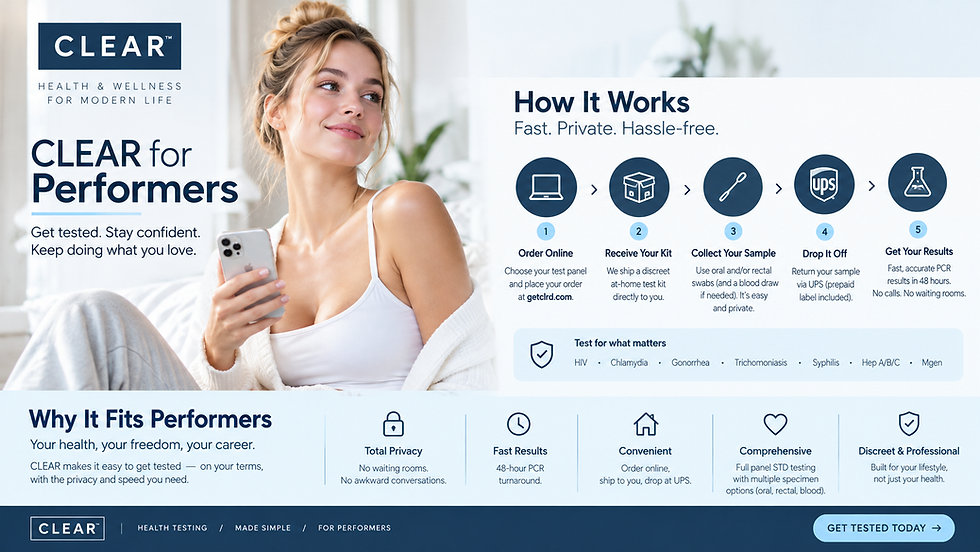
CLEAR Pass™ uses PCR-based analysis in a certified medical laboratory and covers HIV, chlamydia, gonorrhea, syphilis, and hepatitis B and C. Urine, oral, and rectal samples can be collected privately at home. For blood collection, visit a CLEAR location or one of 200+ partner sites nationwide. Results are delivered to your personal CLEAR account within 48 hours.
It’s built for people who need a result they can rely on, not just a fast one. 🤍
🔗 Learn more via the link in Bio.
Bottom line
Speed and accuracy aren’t the same thing. For performers, where the window between exposure and detection affects everyone you work with, PCR is the more reliable foundation. Keep rapid tests for what they’re good at, and use PCR for the screening that your professional routine depends on. 🤍
The information in this article is intended for general educational purposes only and does not constitute medical advice. Please consult a qualified healthcare professional for personal medical guidance.


Comments