Sexual Health for Travelers — How to Test When You're Abroad

Travel changes a lot of things. Your routine. Your environment. Your access to the services you normally rely on. And for many people, it also changes their sexual behaviour — new places, new people, new situations that might not have arisen at home.
None of this is a judgment. It's simply the reality of how travel affects people's lives — including their sexual health. And the practical question that follows from it is one that most travel health advice doesn't adequately address: what do you actually do about sexual health testing when you're not at home?
Here's a practical guide.
Why travel and sexual health intersect
Research consistently shows that people are more likely to have new sexual partners while traveling than in their everyday lives. The combination of unfamiliar environments, reduced social accountability, and the general loosening of routine that travel produces creates conditions where sexual encounters happen that might not have at home.
This isn't unique to LGBTQ+ travelers or to any particular demographic. It applies broadly — to business travelers, holidaymakers, people studying abroad, and long-term travelers alike.
The sexual health implications are straightforward. More new partners means more potential exposure points. Different geographic regions have different STI prevalence rates — meaning the risk profile of a new partner can vary significantly depending on where you are. And being away from your usual healthcare provider means that the support systems you'd normally rely on may not be available.
Understanding this doesn't mean avoiding sex while traveling. It means being prepared.
Before you travel — what to do
The most practical thing you can do for your sexual health as a traveler is test before you leave.
Knowing your current status before you go means that whatever happens during travel, you have a clear baseline. A negative result before departure means that any positive result after return reflects something that happened during travel — which is useful information for contact tracing and treatment.
If you're on PrEP, ensure you have enough medication to cover your travel period — including buffer for delays. PrEP requires consistent daily dosing to be effective, and running out while abroad is a preventable problem that planning addresses.
Check vaccination status before international travel. Hepatitis A and B vaccines are particularly relevant for sexually active travelers. Mpox vaccination may also be relevant depending on your destination and risk profile.
If you use barrier methods consistently, pack enough for the duration of travel. Condom quality and availability vary significantly between countries — relying on finding them locally introduces unnecessary uncertainty.
During travel — practical considerations
PEP access varies dramatically by country. PEP — Post-Exposure Prophylaxis for HIV — needs to be started within 72 hours of a potential exposure to be effective. In many countries, PEP is available through emergency departments or sexual health clinics. In others, it's difficult or impossible to access. Knowing in advance whether PEP is accessible in your destination — and how to find it quickly if needed — is worth researching before you leave.
Local sexual health services exist in most major cities. Sexual health clinics, LGBT health centres, and NGO-run services in many destinations offer STI testing — sometimes free or low cost. A quick search before or during travel can identify options in your location.
Barrier use remains important even on PrEP. PrEP provides strong protection against HIV but doesn't cover other STIs. Consistent condom use during travel reduces risk across the full range of infections — including chlamydia, gonorrhea, syphilis, and herpes — in ways that PrEP alone doesn't.
Be aware of local legal context. In some countries, same-sex activity is criminalised, and accessing sexual health services may carry social or legal risk for LGBTQ+ travelers. Knowing the legal and social context of your destination before you travel is an important part of staying safe — in a broader sense than just health.
After you return — testing timeline
Testing after travel is as important as testing before. The timing depends on the window periods of the specific infections you're concerned about.
For most common bacterial STIs — chlamydia, gonorrhea — PCR-based testing can detect infection within 1–2 weeks of exposure. Testing 2–3 weeks after return gives a reliable result for these infections.
For HIV, PCR testing can detect infection as early as 10–14 days after exposure. Testing 2–3 weeks after return covers the HIV window period effectively with PCR.
For syphilis, the window period is longer — typically 3–6 weeks. If there was potential syphilis exposure during travel, a second test at 6 weeks after return provides more certainty than a test taken immediately.
For hepatitis C, the window period is up to 8–11 weeks with standard testing. If there was potential exposure, testing at 3 months after return gives the most reliable result.
The practical approach — test 2–3 weeks after return for HIV, chlamydia, and gonorrhea, and again at 6 weeks for syphilis if relevant. This covers the window periods of the most common infections without requiring a long wait.
Where CLEAR fits in — for before and after travel
CLEAR's at-home Ship Kit makes the before-and-after testing approach as frictionless as possible. Test before departure to establish a clean baseline. Test after return — at the appropriate window period — to identify anything that may have happened during travel.
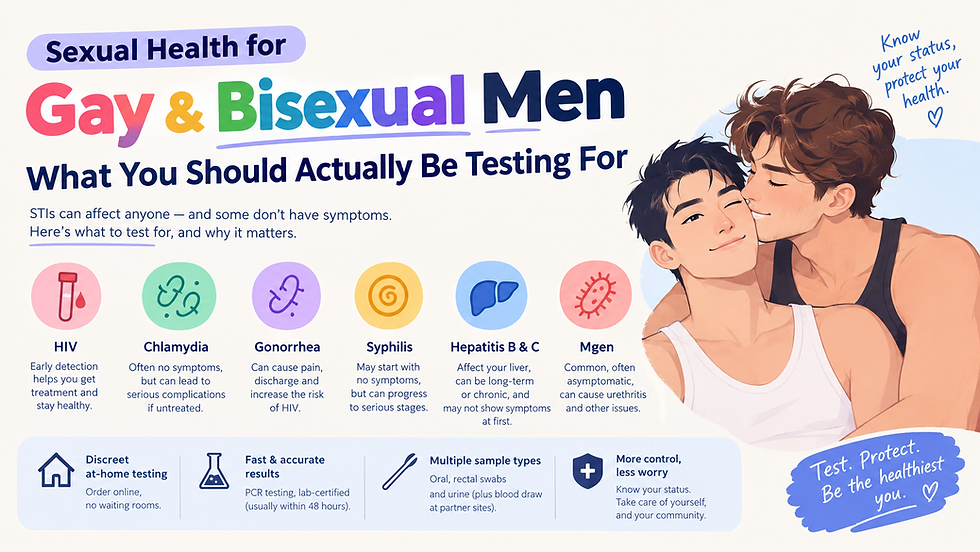
Comprehensive coverage — HIV, chlamydia, gonorrhea, syphilis, and hepatitis B and C — using PCR-based analysis in a certified medical laboratory. Urine, oral, and rectal samples included. Results in 48 hours, delivered privately to your CLEAR account. No appointment. No waiting room. No disruption to your schedule around travel. 🤍
For the testing that happens while you're away — CLEAR's kit can be ordered and collected before you leave, but samples need to be shipped from within the US via UPS. For testing during international travel, local services are the practical option.
🔗 Learn more via the link in Bio.
For LGBTQ+ travelers — specific considerations
For LGBTQ+ travelers, the sexual health considerations of travel intersect with identity-specific factors worth naming.
In destinations where LGBTQ+ identities are stigmatised or criminalised, accessing sexual health services may require navigating additional barriers — providers who aren't affirming, environments that don't feel safe, or legal contexts that make disclosure of sexual practices risky.
LGBTQ+-specific travel resources — including destination guides that cover healthcare access, legal context, and community resources — are available through organisations including ILGA World and local LGBTQ+ travel communities. Knowing what's available before you arrive is significantly easier than figuring it out under pressure.
For gay and bisexual men traveling to destinations with higher HIV or STI prevalence, the case for being on PrEP before departure — rather than relying on condoms alone — is particularly strong.
Bottom line
Travel and sexual health are connected in ways that most travel advice doesn't adequately address. The practical response is simple — test before you leave, know your prevention options, be prepared for the possibility of needing PEP, and test again when you return at the appropriate window period.
None of this requires avoiding intimacy while traveling. It requires the same proactive, informed approach to sexual health that applies at home — applied to a context where the usual support systems may be less accessible.
Know before you go. Test when you return. And enjoy the trip. 😊
The information in this article is intended for general educational purposes only and does not constitute medical advice. Please consult a qualified healthcare professional for personal medical guidance.


Comments