🌱 Building Your STI Testing Habit in Your 20s — Why Starting Now Changes Everything

Your 20s are when habits form. Not just the habits you consciously build — the gym routine, the sleep schedule, the morning practice — but the ones that form by default, from the accumulated choices you make when life is busy and the consequences feel distant.
Sexual health habits are no different. The pattern you establish in your 20s — whether you test regularly, whether you have honest conversations with partners, whether you treat sexual health as a routine part of self-care or as something you only engage with reactively — is the pattern that tends to persist.
And the stakes of getting that pattern right are higher than most 20-something people realise.
Why your 20s are the decade that matters most
The 15–24 age group accounts for a disproportionate share of new STI diagnoses globally — not because young people are reckless, but because of exposure patterns, testing rates, and the simple reality that this is when most people are building their sexual lives.
More new partners. Less consistent barrier use. Less regular testing. More assumptions that STIs are something that happens to other people. These factors combine in a way that makes the 20s both the highest-risk decade and the one where proactive habits would have the greatest impact.
There's also a forward-looking argument. STIs that are caught and treated early — particularly bacterial infections like chlamydia, gonorrhea, and syphilis — are straightforward to manage. Left untreated, they can cause complications that affect fertility, long-term health, and quality of life in ways that become apparent only in the 30s, when the window for easy intervention has closed.
The habits you build at 22 protect you at 32. That's not abstract. It's the actual timeline.
What a testing habit actually looks like
A habit isn't something you decide to do each time. It's something that happens automatically — because the decision has already been made, and the trigger, the routine, and the reward are all in place.
For STI testing, building a habit looks like this.
Decide on a frequency — and commit to it, not to symptoms. For sexually active people with multiple partners or inconsistent barrier use, every three months is the evidence-based recommendation. For those in more stable situations, annually at minimum and at the start of any new relationship. The schedule is what determines when you test — not how you feel.
Connect it to something that already happens. Habit research consistently shows that new habits stick when they're anchored to existing routines. Every quarter — the same week as your rent is due, or the first week of each new season, or at the same time as your regular dental check-up — makes the timing automatic rather than effortful.
Remove the decision from the moment. The biggest barrier to testing isn't usually intention — it's friction. The appointment to book, the time to find, the clinical environment to navigate. When testing requires minimal active decision-making in the moment — because the kit is already ordered, because the process is at home, because results appear privately without effort — following through is significantly easier.
Treat results as information, not verdicts. A positive result, handled promptly, is a straightforward medical situation. The habit of testing includes the habit of responding to results calmly — getting treatment, informing partners, moving forward. This is part of what makes the habit sustainable — if a positive result feels catastrophic, the habit of testing becomes associated with dread rather than routine.
The 20s testing checklist — what to actually do
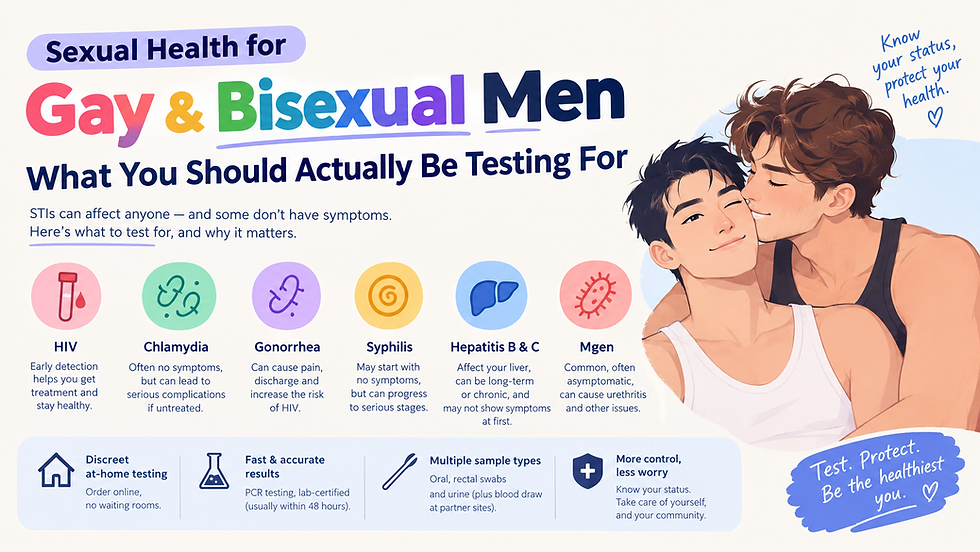
Testing every three months for the core infections — HIV, chlamydia, gonorrhea, and syphilis — is the foundation.
For anyone engaging in oral or anal sex, site-specific testing matters — oral and rectal swabs alongside urine, not just urine. A urine-only test misses infections in the throat and rectum, which are almost always asymptomatic.
Vaccinations to complete in your 20s if not already done — HPV, Hepatitis A, and Hepatitis B. These eliminate risks that regular testing doesn't address.
PrEP — if you're at substantial ongoing HIV risk, your 20s are the time to start, not to defer.
Regular cervical screening — for anyone with a cervix, regardless of sexual orientation or perceived risk level.
The partner conversation — building that habit too
The testing habit doesn't exist in isolation. It connects to the habit of having honest conversations with partners about sexual health — before intimacy, not after.
Gen Z is increasingly treating this conversation as a normal part of the talking stage — the same due diligence applied to compatibility conversations. Asking about testing history, sharing your own, discussing prevention approaches — these are habits that form in the 20s and either become normalised or remain awkward depending on whether you practice them.
The first few times feel strange. The tenth time feels like nothing. That's how habits work.
Where CLEAR fits into building this habit
CLEAR's at-home Ship Kit was designed to remove the friction that keeps the testing habit from forming.
Order online. Collect at home — urine, oral, and rectal samples with a clear guide. Drop off at UPS. Results in 48 hours in your CLEAR account. Private. No appointment. No waiting room. No disruption to a busy schedule.
For a generation that expects health services to be digital, private, and on their terms — CLEAR makes regular testing achievable as a genuine habit rather than an occasional event.
Build the habit in your 20s. Your 30s will thank you. 🤍
🔗 Learn more via the link in Bio.
The bottom line on starting now
Habits are easier to build before you have a reason to regret not having them. The STI testing habit — built into your routine in your 20s, before a scare or a diagnosis or a consequence forces the issue — is one of the most practical health decisions available to this generation.
Start now. Make it routine. Let it become unremarkable. That's how proactive sexual health works — not as a dramatic intervention, but as a quiet, consistent practice that compounds over time into genuinely better health outcomes.
Start at 20. Keep going at 30. That's the habit. 😊
The information in this article is intended for general educational purposes only and does not constitute medical advice. Please consult a qualified healthcare professional for personal medical guidance.


Comments