🤍 STIs and Open Relationships — What You Actually Need to Know
- natcha K
- 1 day ago
- 4 min read

Open relationships — where partners agree to have romantic or sexual connections with people outside their primary relationship — are more common than public conversation tends to acknowledge. For many couples, they work well. And like any relationship structure, they come with a specific set of sexual health considerations that deserve honest, practical discussion.
This isn't about judging relationship structures. It's about making sure the people in them have accurate information.
What an open relationship means for STI risk
More sexual partners means more potential exposure points. That's a straightforward mathematical reality — not a moral judgment. In any relationship structure, STI risk is determined by exposure and prevention, not by the number of people involved or the type of relationship it is.
What changes in an open relationship is that the sexual health decisions of multiple people are connected. If one person in a network has an undetected STI, it can move through that network before anyone is aware. The solution to this isn't avoiding open relationships — it's building sexual health practices that match the actual risk profile.
Communication — the foundation of everything
Open relationships that prioritise sexual health start with honest communication. That means conversations about testing frequency, about what happened and with whom, about any potential exposures, and about what prevention methods are being used consistently.
These conversations are easier when they happen as a regular part of the relationship rather than only when something goes wrong. Building a norm of openness about sexual health — within the primary relationship and with other partners — is the single most protective thing a person in an open relationship can do.
Testing frequency — how often is enough?
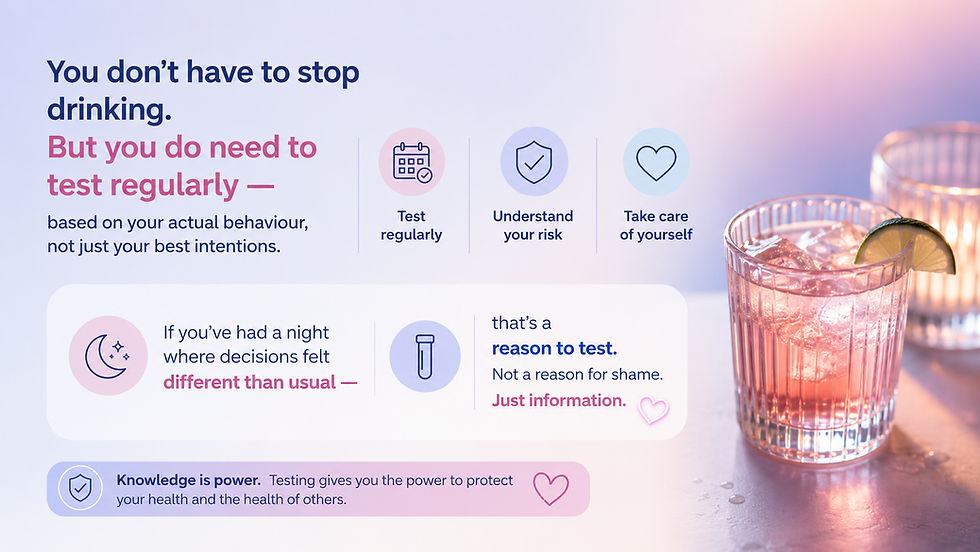
For anyone in an open relationship with multiple partners, the standard recommendation is testing every three months for the most common STIs — HIV, chlamydia, gonorrhea, and syphilis. This frequency allows for early detection before complications develop or infections spread through a partner network.
Some sexual health practitioners recommend more frequent testing — monthly — for people with higher numbers of partners or less consistent barrier use. The right frequency depends on your actual situation, not a one-size-fits-all rule.
Testing after each new partner is also a practical approach — particularly if barrier methods weren't used consistently, or if there's uncertainty about a partner's status.
Site-specific testing matters
Standard STI screens often default to urine testing — which only covers urethral infections. For anyone engaging in oral or anal sex, this is insufficient.
Chlamydia and gonorrhea can infect the throat and rectum independently, and infections at these sites are almost always asymptomatic. A comprehensive screen covering urine, oral, and rectal samples gives a complete picture of actual status — not just one route of infection.
CLEAR™'s Ship Kit includes collection materials for all three sites — with a clear Self-Collection Guide — so your results actually reflect your exposure.
Barrier methods — what they cover and what they don't
Consistent condom use significantly reduces the risk of HIV, chlamydia, gonorrhea, and trichomoniasis. For people in open relationships with multiple partners, consistent barrier use is one of the most practical risk-reduction tools available.
But condoms don't protect against everything. Herpes and HPV spread through skin-to-skin contact in areas not covered by a condom. This means that even with consistent condom use, regular testing remains important — because some infections can transmit despite correct barrier use.
PrEP — relevant for many people in open relationships
For people in open relationships who are at substantial ongoing risk of HIV, PrEP — Pre-Exposure Prophylaxis — is worth discussing with a healthcare provider. Taken consistently, PrEP reduces the risk of HIV from sex by approximately 99%.
PrEP doesn't replace regular STI testing — in fact, people on PrEP are typically recommended to test every three months as part of their standard protocol. But for those at higher HIV risk, it adds a significant layer of protection that barrier methods alone can't provide.
Disclosure — what you owe your partners
This is one of the more nuanced aspects of sexual health in open relationships. If you receive a positive STI result, informing recent partners — so they can test and, if necessary, receive treatment — is an important part of responsible sexual health care.
This can feel difficult, particularly if it involves conversations with multiple people or with partners your primary partner doesn't know about. Some sexual health clinics offer anonymous partner notification services — where the clinic contacts recent partners on your behalf without revealing your identity — which removes some of the social complexity.
The sooner a positive result is disclosed, the sooner everyone in the network can act. Delaying because the conversation is uncomfortable doesn't protect anyone.
Where CLEAR™ fits in
For people in open relationships, the accessibility of at-home testing makes a practical difference. Testing every three months — or after each new partner — is a more achievable commitment when it doesn't require booking a clinic appointment each time.
CLEAR™'s at-home Ship Kit covers comprehensive STI screening — including HIV, chlamydia, gonorrhea, syphilis, and hepatitis B and C — using PCR-based analysis in a certified medical laboratory. Results are delivered privately to your CLEAR™ account within 48 hours.
Urine, oral, and rectal samples are all included — so your results reflect your actual exposure, not just one route of infection. 🤍
🔗 Learn more via the link in Bio.
Open relationships don't require a fundamentally different approach to sexual health — they require the same approach, applied more consistently and communicated more explicitly. Test regularly. Know your status. Talk to your partners. Use barriers where you can. And make sure the testing you're doing actually covers all the relevant sites.
The relationship structure is your choice. The health care is non-negotiable. 😊
The information in this article is intended for general educational purposes only and does not constitute medical advice. Please consult a qualified healthcare professional for personal medical guidance.

Comments