📝 “You Know You Should Get Tested. So Why Haven’t You?”

You know. You’ve known for a while. Maybe it’s been three months. Maybe six. Maybe longer than you’d like to admit.
The intention is there. The follow-through isn’t. And if you’re honest with yourself — you’re not entirely sure why.
This blog is for that gap — between knowing and doing. Between the intention and the action. Between “I should get tested” and actually getting tested.
Here’s what’s actually in that gap — and how to close it.
The reasons people give — and what’s really behind them
“I feel fine, so I’m probably fine.”
This is the most common one. And it’s the most consequential.
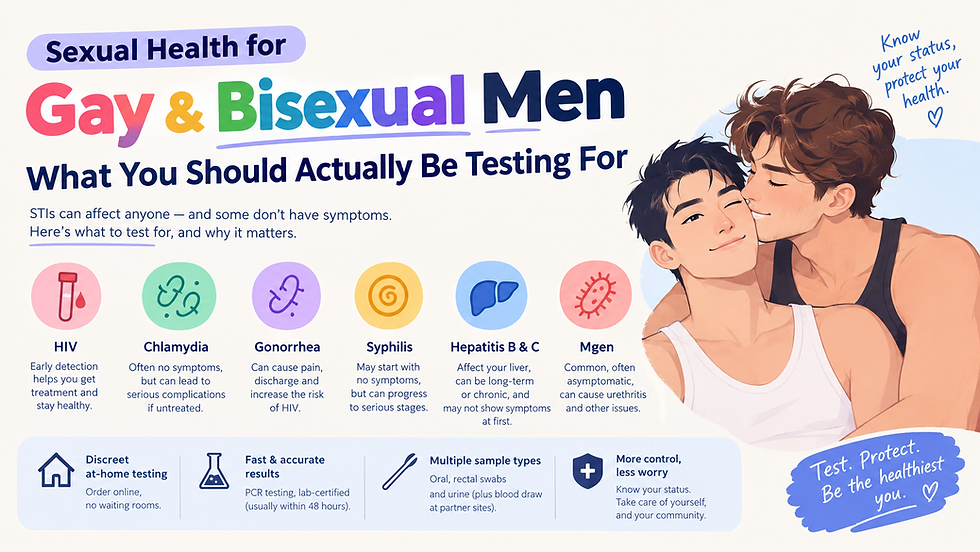
Most STIs produce no symptoms — particularly in the early stages, and often indefinitely. Chlamydia is asymptomatic in up to 80% of cases. Gonorrhea frequently produces no symptoms at all, especially when it infects the throat or rectum. HIV causes a brief flu-like phase that most people attribute to something else, then nothing for years. Herpes can be carried without ever producing a recognisable outbreak.
Feeling fine is evidence that your body is functioning. It is not evidence of your STI status. The infections most worth knowing about are precisely the ones least likely to announce themselves.
The logic of “I feel fine” is a trap — not because it comes from bad intentions, but because it applies a framework that works for most health situations to one where it consistently doesn’t.
“The clinic thing feels like too much.”
This one is honest — and understandable. The appointment to book, often days or weeks in advance. The time off work or rearranged schedule. The journey. The waiting room. The conversation with a receptionist about why you’re there. The wait for results.
For something that doesn’t feel urgent — because there are no symptoms, because it’s been added to a mental to-do list rather than a calendar — that friction is enough to keep it perpetually deferred.
The friction isn’t imaginary. But it’s also not fixed. More on that below.
“I’m a little scared of what the result might be.”
This is the one people are least likely to say out loud — and the one that’s often most true.
The fear of a positive result is real. For many people, it operates quietly in the background — not consciously directing behaviour, but influencing it. If finding out means potentially finding something, then not finding out feels safer.
It isn’t. Not knowing doesn’t make anything better. It means carrying the uncertainty — and potentially the infection — while believing you’re protected by ignorance. A positive result, handled promptly, is a medical situation that can be acted on. Uncertainty, prolonged indefinitely, is its own burden — and it means the window for straightforward treatment keeps narrowing.
The fear of a result is understandable. Acting on it by not testing is not the version of that fear that serves you.
“I’ll do it next week.”
And then it’s the week after. And then the month after. And then six months have passed since you last thought seriously about it, and the intention is still there — untouched, unacted on, slightly more uncomfortable to look at directly.
Deferred intentions don’t become actions without a specific, concrete trigger. “Next week” is not a trigger. “Tuesday at 10am” is.
What’s actually in the gap
Between knowing and doing, there are usually two things — friction and emotion.
Friction is everything that makes the action harder than it needs to be. Booking systems. Clinical environments. Waiting times. Scheduling conflicts. All the practical obstacles between intention and execution.
Emotion is the fear, the avoidance, the sense that not knowing is somehow less uncomfortable than knowing. The assumption that a positive result would be unmanageable. The background anxiety that testing might confirm something.
Both are addressable. Neither requires heroic effort. They just require being named clearly enough to respond to.
Addressing the friction
The most direct response to friction is removing it.
At-home testing removes the waiting room, the appointment, the scheduling conflict, and the clinical environment from the process entirely. You collect samples at home, in your own time. You don’t need to take time off work. You don’t need to interact with anyone about why you’re there.
CLEAR’s at-home Ship Kit covers comprehensive STI screening — HIV, chlamydia, gonorrhea, syphilis, and hepatitis B and C — using PCR-based analysis in a certified medical laboratory. Results in 48 hours, delivered privately to your CLEAR account.
No appointment. No waiting room. No reason that friction was the barrier.
Addressing the emotion
The fear of a positive result deserves a direct response — not reassurance, but accuracy.
For curable infections — chlamydia, gonorrhea, syphilis — treatment is a course of antibiotics. The infection clears. A follow-up test confirms clearance. That’s it.
For manageable infections — HIV, herpes — treatment doesn’t cure, but it controls. People living with HIV on effective treatment have life expectancies comparable to people without HIV. People with herpes manage outbreaks — many people have them rarely or never — and antiviral medication reduces transmission risk significantly.
None of these outcomes require the kind of fear that keeps people from testing. And all of them are significantly more manageable when caught early — which is only possible through testing.
The fear is understandable. The conclusion it tends to produce — not testing — makes every outcome worse, not better.
Reframing what testing means
The frame that makes testing feel loaded — a response to something potentially wrong, a risk to be assessed, an outcome to be feared — is the wrong frame.
The right frame is routine maintenance. The same logic as a dental check-up — you don’t wait until your teeth hurt. The same logic as an annual physical — you don’t wait until something is obviously wrong.
Regular STI testing is maintenance. It happens because it’s scheduled, not because something prompted it. It produces information — clear or not — that allows you to take care of yourself and the people you’re intimate with. That’s all it is.
The moment it becomes routine rather than event-driven, the gap between knowing and doing largely closes on its own.
Making it actually happen
The research on habit formation is consistent on one point — new behaviours stick when they’re specific, scheduled, and attached to existing routines.
Decide now — not “next week.” Decide when you’re testing. Put it in your calendar. Make it quarterly — the same week every three months, attached to something that already happens.
Order the kit before the motivation fades. The window between “I’m going to do this” and “I’ll do it later” is narrow. Closing it in the moment — placing the order while the intention is present — is significantly more reliable than trusting future motivation.
Remove the decision from the moment of testing. When the kit is already there, when the process is familiar, when the schedule says it’s time — there’s no active decision required. The habit runs itself.
The one result that changes nothing
A negative result means you’re clear. A positive result means you have information to act on. Both are better than the result you never get.
The only outcome that leaves you no better off than before is not testing at all. That’s the only result that genuinely changes nothing — because it replaces information with continued uncertainty, and uncertainty with continued risk.
You already know you should. That knowledge has been there for a while.
The gap between knowing and doing is smaller than it looks. It just needs to be closed once — and then again, three months from now, when the calendar says it’s time.
CLEAR makes that as easy as it’s ever been. 🤍
🔗 Learn more via the link in Bio.
The information in this article is intended for general educational purposes only and does not constitute medical advice. Please consult a qualified healthcare professional for personal medical guidance.


Comments